

Protocol: Finding the tipping point

We have now reached the point where we have created common knowledge, our rituals are helping to spread said knowledge, and we’re even actively identifying times where said knowledge is being mis-interpreted and are proactively taking steps to correct those situations. Considering we’re just getting started, we’re making good progress.
Let’s talk about homeostasis. Think about the human body; a healthy human being maintains a stable heart rate, temperature, blood pressure, etc. This is homeostasis in action: the maintenance of a stable environment. Now think about our CASTes; absent unplanned perturbations, our environment is mostly stable and predictable. I daresay that most if not all large CASTes have organized and optimized themselves to both maintain stability and predictability as well as minimize the opportunity for risk and or unplanned events to sneak in and unbalance the system.
What we are trying to do is to in effect move the CASTe out of a state of homeostasis; we are trying to do this by purposeful evolution of a new egregore that will lead to lasting change. However the system, being optimized to maintain stability, will “push back’’ against our attempts to change it. This may not be intentional, but more like antibodies attacking an infection; there is no conscious thought in our antibodies, they are doing what they have been programmed and optimized to do. “If all this is true,” you’re saying, “how do we get the system to become open to and in fact accept change?’’ We do this by creating a…catastrophe.
I’m assuming that your face right now is scrunched up with a grimace, as the word ‘’catastrophe” probably evokes a visceral reaction. Maybe you pictured the ending of the movie Deep Impact (showing my age) or 2012 (that’s a bit younger.) The Latin roots of this word translate to ‘’down turning”, and most people view catastrophes as an event with a negative connotation, typically as a synonym for a ‘’disaster.” I’m going to challenge that notion and offer up this counterpoint: what if a catastrophe could be a good thing?
Another way to think about a catastrophe, which suits this book best, is a catastrophe as a phase shift; like ice melting to water, we are going to define a catastrophe as ‘’something that happens that prevents us from going back to the way things were.” This is not necessarily bad or good, it’s an occurrence that one it happens it marks a change in the environment that cannot be undone (at least without major energy expenditure and minor loss; you can re-freeze water into ice but it requires a freezer, electricity, and there will be some loss of the ice cube’s size.) What we are going to be talking about is things changing into whatever the “new normal” will be.
Believe it or not, there’s some mathematical science behind catastrophes! Rene Thom was a French mathematician whose primary work was in mathematical topology (oversimplified: geometry and its attributes.) What is today called Catastrophe Theory comes from his work in bifurcation theory in dynamical systems…think “shifts in behaviour, sometimes sudden, which arise from many smaller changes.” Thom was studying systems and how they can take on a trajectory where they ‘’tip over’’ into a new state, and as a result he created a bunch of models to show how these catastrophes work. The cusp model below is an example.
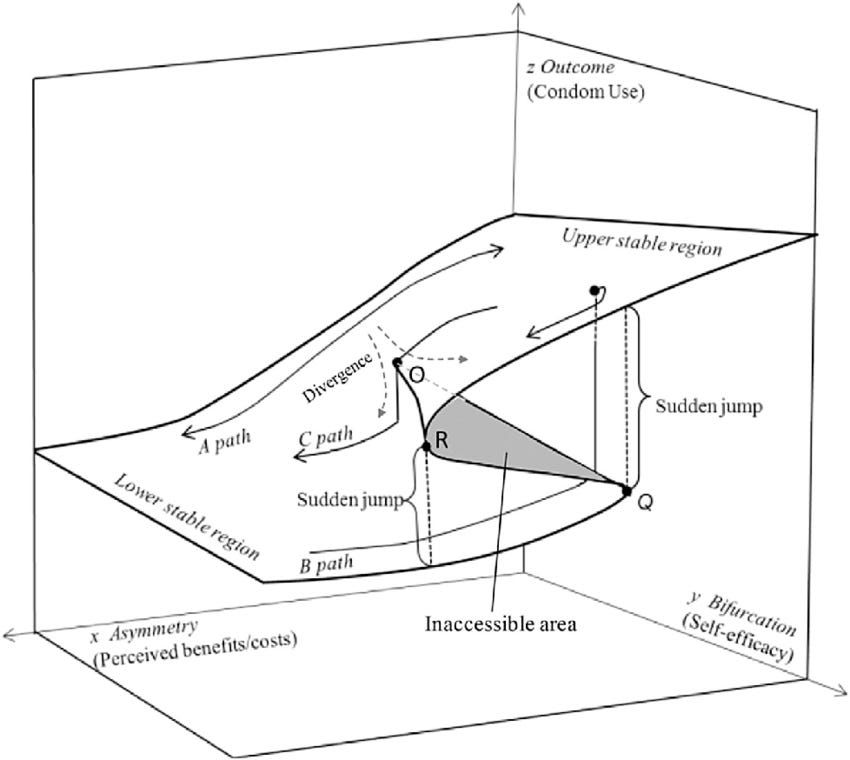
As you can see by the diagram, there is an upper stable state which represents the current normal. From there two options for phase shift exist: a stable, gradual movement towards the lower stable state (“the new normal”) and a sudden jump into the lower stable state…these sudden jumps are catastrophes. You’ll also notice that there are two sudden jumps, one early on in the curve and one later as the curve takes on a more drastic bend; we can interpret this as there are at least two opportunities for us to move into the “new normal” at speed.
So how do we find these catastrophes? By creating common knowledge and using rituals to help it spread, we’re already on our way, but we can purposefully create catastrophes to aid our evolution by maximizing how far these new ideas (and by extension, our new culture) spread into the CASTe. What we’re looking to do is create a large enough surface area of the egregore that will maximize exposure to it, while not over-extending too far, too fast, and running the risk of a premature end to our intentional evolutionary journey. The first marker we should target in this effort is defined by a number: five percent.
Everett M. Rogers was an American sociologist and communication theorist. What he is best known for is also arguably his biggest contribution to his field: his seminal work, Diffusion of Innovation. This book describes how and at what rate new ideas spread in a system/culture/society. His theory is that when five (5) percent of a population accepts a new idea, said idea becomes embedded within a culture. Once an idea is embedded it is considered “stuck”, and virtually no amount of force or effort will be able to dislodge this idea from the prevailing corporate culture. I’m confident many readers can think of an CASTeal change program they’ve been aware of or involved in, that while it failed to get mass adoption, there are pockets inside the CASTe that have really taken the concepts in that change to heart and are actively utilizing them, regardless of where the CASTe has gone since…those are embedded ideas.
Applying this theory to our efforts, we are looking to ensure that 5% of our population has been exposed to and is actively adopting and contributing to our evolutionary egregore. We do this by monitoring the stories and narratives that are currently being passed around the CASTe. We can also do this by noting the attendees of our rituals, and who consistently attends these conversations, and more importantly, who is bringing others into said rituals. Monitoring this activity will help give us insight into how much additional effort we need to put into our intentional evolution to hit the NEXT marker…
The next marker in Everett’s Diffusion of Innovation is twenty percent; Everett states that when an idea hits 20% adoption in an CASTe that idea is said to be unstoppable. This means that the idea has reached a point where it is virtually impossible to remove it from the CASTe, and the idea has now become part of the definition of the “new normal’’ that is represented by our evolutionary egregore. At 20% we have created a catastrophe that there is no going back from, and we are now solidly moving in the direction that we wish to go.
One way to visualize company culture is by comparing it to a gravity well; this is a giant funnel that is typically paired with a black hole in astrophysics. A gravity well is a giant drain that pulls everything and anything in its vicinity towards it and deep into the black hole below, which is much how corporate culture works. No matter who joins the CASTe, no matter how long an employee has been with the company, eventually ‘’gravity wins’’ and they end up pulled into the well that is the overriding norms of the CASTe.
Building on this metaphor…our evolutionary egregore is a competing gravity well, and what we’re looking to do with these catastrophes is perturb the culture so that we pop up out of the current gravity well: that creates the optionality of either ‘’going back into the well we were just in”, or going somewhere novel. Our hope is that we create enough of a basin of attraction (h/t Jim Rutt) that when perturbed up out of the well, people end up in our new well, and by extension part of the evolutionary egregore we’re creating.
How is Everett's Diffusion of Innovation different from Moore's Chasm?